Tuesday, May 12, 2020

Mail Order Beatrice


MAIL-ORDER BEATRICE
historical western romance
Widows, Brides, and Secret Babies Series book 10
By
Caroline Clemmons


ABOUT THE BOOK

Beatrice “Attie” Kendall has to escape from home with her six-week-old son. With the help of her kind brother, she goes to Atlanta where she consults a matchmaker. After the hard life Attie’s been dealt for her twenty years, she’ll finally have a good home with nice people and a friend nearby.  In fact, her husband and their home seem too good to be true. Does she dare trust that her life has really changed?
Tate Merritt isn’t ready to get married but he gives in to his grandfather’s coercing. Grandpa raised him and Tate tries to please the older man. Tate doesn’t know what to think about this mail-order bride. She isn’t at all the wife he imagined—plus, she showed up with a baby! The child’s a cute little thing but Tate isn’t sure how he feels about her surprising him. How can he trust a woman whose story keeps changing?
Life presents obstacles to further complicate Attie and Tate’s marriage. They’ll have to work together to solve their problems and protect their family.  Can they trust one another enough to make this marriage work?

Universal Amazon Link https://mybook.to/Attie

ENJOY AN EXCERPT OF THEIR FIRST MEETING
Here’s an excerpt of when they meet:
Tate’s misgivings grew as the stage came closer. By the time the vehicle stopped in front of them, he was ready to turn tail and run for home. He’d given his word, though, and he never broke his word. That meant he’d stand here and look halfway pleased his bride had arrived—if she had.
First person off the stage was a pretty brunette. She turned back and took a basket from inside the stage and held it while a beautiful blonde stepped out. The blonde took the basket and hugged the brunette.
Reg walked up to the brunette. “You must be Hannah. I’m Reggie.” They walked off to where his parents stood.
Grandpa nudged him. “Son, are you nailed to the boardwalk?”
He came out of his reverie and walked to the blonde. She was a pretty woman and had a real sweet expression on her face.
“I’m Tate Merritt. Are you Beatrice Bishop?”
“I am. My friends call me Attie, but whichever you please is fine.”
“Shall I take the basket?”
“If you don’t mind.” She handed it to him and removed the cloth she had covering the basket.
He glanced at the contents then stared. “It… It’s a baby. I didn’t know you were bringing a baby. Is this kid yours?”
Her chin came up. “His name is Wade. I’m a widow, you see, and Wade is my son.”
Grandpa had strolled over and peered at the basket’s contents. “Well, I’ll be if that isn’t a cute little sprout. Wade you say? Looks like a fine boy.”
Her face radiated such joy her beauty increased. “He is a very good boy. I’m fortunate to have him.”
She looked at Tate. “I didn’t have a chance to let you know I was bringing him but the matchmaker said from what your minister wrote that she was sure you’d not mind. Your preacher mentioned what a kind and loving family yours was.”
Grandpa stood there grinning like a fool which certainly was no help.
“You’re here so I suppose we’ll manage. We’re due at the church now. I’ll load your luggage if you’ll show me which is yours.”
Grandpa reached for the basket. “I’ll take charge of my great-grandson.”
Muttering under his breath, Tate escorted his used bride to the pile of luggage the stage driver had set on the boardwalk.
Attie reached for a carpetbag. “This and that small trunk there. The brown one.”
“That’s all?”
“It is.” She raised her chin again—defiantly, he thought, but he supposed it could have been the difference in their height.
He gauged her size and judged her to be about six or seven inches over five feet. Her eyes were the brightest blue he’d ever seen. In addition to being wrinkled from the trip, her dress was plain and frayed at the cuffs and the hem.
Reg and his father loaded a large trunk and valise onto their wagon.
Reg laughed. “Funny our mail-order brides being friends, isn’t it? Guess you’re going to the church next so we’ll see you there.”
“You know Mr. Spencer?” His used bride touched his arm and appeared excited. “Why, that’s wonderful. Hannah and I are good friends. I hope we can visit them sometimes.”
He hefted a trunk and a heavy carpetbag. “Sure I know him. Guess I know about everyone in this county and the next. There aren’t that many of us.”
She kept step with him. “I get the feeling you’re not happy about the baby and me being a widow instead of never wed. I can understand that but I hope you won’t send me back.”
He stopped and looked at her. “Attie, I’m not sending you back. I can’t help being a little upset because I didn’t know you had a baby or that you were a widow.”
He started walking again. “I had this picture in my head. Give me a little time to get my mind changed around to the real you.”

ABOUT CAROLINE CLEMMONS
Through a crazy twist of fate, Caroline Clemmons was not born on a Texas ranch. To compensate for this illogical error, she writes about handsome cowboys, feisty ranch women, and scheming villains in a tiny office her family calls her pink cave. She and her Hero live in North Central Texas cowboy country where they ride herd on their two rescued indoor cats and dog as well as providing nourishment for outdoor critters.
The books she creates in her pink cave have made her a bestselling author and won awards. She writes sweet to sensual romances about the West, both historical and contemporary as well as time travel and mystery. Her series include the Kincaids, McClintocks, Stone Mountain Texas, Bride Brigade, Texas Time Travel, Texas Caprock Tales, Pearson Grove, and Loving A Rancher as well as numerous single titles and contributions to multi-author sets. When she’s not writing, she loves spending time with her family, reading her friends’ books, lunching with friends, browsing antique malls, checking Facebook, and taking the occasional nap. Find her on her blog, website, Facebook, Twitter, Goodreads, and Pinterest.
Join her and other readers at Caroline’s Cuties, a Facebook readers group at https://www.facebook.com/groups/277082053015947/ for special excerpts, exchanging ideas, contests, giveaways, recipes, and talking to like-minded people about books and other fun things.
Click on her Amazon Author Page for a complete list of her books and follow her there.
Follow her on BookBub.
To stay up-to-date with her releases and contests, subscribe to Caroline’s newsletter here and receive a FREE novella of HAPPY IS THE BRIDE, a humorous historical wedding disaster that ends happily—but you knew it would, didn’t you?

Thursday, May 7, 2020

Spins are Wild


Lora's in the middle of a messy divorce with her bull rider ex-husband. Just because she left the WBR circuit and is making a name for herself as a trainer, now his buckle bunny of a girlfriend thinks she can take half of Lora's farm, her two best horses, and even her truck and trailer in the divorce and do the same thing. Lora's tired of propping up Billy and it is long past time he learned to cowboy up and take responsibility for his own life. She's swearing off men for good. Until her best friend introduces her to an up and coming D-series barrel racer with plans of his own.

Note: This women's fiction story contains romantic elements and the romantic plot grows stronger as the series continues. 

Excerpt
“Lora!” Arden jumped out of the cab of the truck, looking so put together as always, with her light brown hair pulled back in a ponytail, her Weaver t-shirt tucked into her jeans, and her buckle from winning a round of the NFR a few years ago, glinting with the setting sun. Her boots, as brilliant turquoise as her truck, looked brand new. She raced across the gravel and pulled Lora into a hug, heedless of the eu de Vetrolin clinging to her. At least she smelled minty. “How the hell are you?”
“Better now that you’re here.” Lora stepped out of the embrace in time to see a man step out of the passenger side of the truck. “You didn’t tell me your friend is a guy. You have someone new? I thought you and Toby were engaged?”
Arden laughed. Her usual loud and boisterous laughter rang through the air and startled a flock of sparrows. “Clint? Oh god no, we’re not dating. He’s just a friend. He rides barrel racers and is riding shotgun with me for the next six weeks while his horse heals so he can get a feel for what the big leagues are like.” She motioned him over. “Come meet, Lora.” Arden whispered, “I think he’s a bit star struck at the moment.”
Clint’s long legs carried him across the gravel, his boots worn, his jeans worn in all the right places, and a plain black shirt stretched across his chest. An easy smile lit his face and his green eyes sparkled. The wind rustled his short-cut reddish brown hair, giving him a cowlick for a moment. “Hi. Arden has spoken a lot about you.” He held out his hand.
She clasped it, taken aback by his appearance and by Arden’s reaction when she’d asked if they were dating. His grip was firm, warm, and when he released her hand, she still swore she felt his touch. Oh no, the last thing she needed was another relationship. Not when the ink on her divorce papers wasn’t even there yet, though hopefully within about two months everything would be final, and she had no idea where Clint would go after his ride-along ended. 
“How many horses have you brought with you? I have three empty stalls, plus can set up the dry lot with a trough and hay for the weekend. Just let me know what you need.” Lora strode toward the trailer where Arden’s horses, Stryker and Timber, were no doubt waiting.
“The usual suspects. If you don’t mind the stalls, and I can clean them and get bedding or pay a day rate if you need me to. I’ll turn them out, but thinking we all need a nice, relaxing weekend.” She opened the big door and fastened it to the side of the trailer. She stepped inside and unfastened Timber’s lead from the side of the trailer and led her out. She passed the lead rope to Lora, who led her into the barn. The three stalls were along one side, closest to the door, and she chose the middle one and led Timber, a muscled chestnut mare, into it. After removing the halter, she shut the door, then went back to the trailer. Arden led Stryker, a big black gelding, and placed him in the stall closest to the door, leaving one empty stall between her horses and the resident ones. Clint filled water buckets while they gave the horses some hay, with Arden assuring that she would make sure they got their grain later. 
“Why don’t we go up to the house? I’ll let you guys argue over who gets the spare bedroom.” Lora said with a glance back at her guests.
“I can sleep in the trailer or a couch. I’ve been known to sleep on a few bales of hay.” Clint replied.
“He’s not kidding. One night he was up walking Stryker because we thought she was colicing. After the episode passed, he said he’d stay in the barn and when I went down in the morning, he was using a horse blanket for a pillow and sleeping on bales of hay.” Arden patted Clint on the shoulder. “He’s a good guy.”
“Sounds like it.” Lora wondered if Arden might be pushing Clint in her direction, and if so they were going to have to have a conversation. By the time they reached the house, Lora knew Arden was playing match maker. 

Buy link:

About The Author
Mary Kit Caelsto never grew out of the phase of being a "horse crazy girl". Though she's now over 40, she's finally fulfilling her dream of writing equestrian books for others who haven't grown out of being "horse crazy". She lives in the Ozarks with her four very spoiled and very opinionated horses, as well as a large flock of poultry and enough cats to qualify her as a crazy cat lady. Her husband, though not an equestrian himself, understands and supports all her equestrian dreams.


She's convinced three of the best things in the world are the smell of a sun warmed horse, the smell of leather tack, and making sure to hug her horses every single day. 


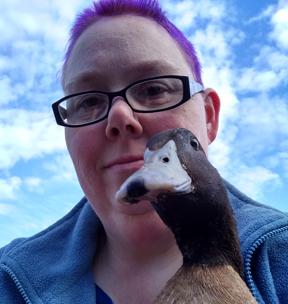
Picture of the author and “SuperDuck” taken 3/2019. Hair color varies depending on mood.


Website: http://marykitcaelsto.com (Visit and sign up for free stories!)
Patreon: https://patreon.com/marykitcaelsto (Patreons receive free stories. Support starts at $1/month.)


Tuesday, May 5, 2020

The Adventure of the Murdered Gypsy


Award-winning Author, Liese Sherwood-Fabre, launches the pre-order for Case Two of The Early Case Files of Sherlock Holmes with a special eBook price through May 8!

The Adventure of the Murdered Gypsy

EXCERPT:

Mother pivoted, swung her foot, and hit her opponent squarely on the jaw. The man landed on his back against the wooden floorboards with enough force to send tremors through the soles of my feet.

Mr. Moto raised himself onto one elbow and rubbed the side of his face with his other hand. “Very good.”

Mother extended her hand to our baritsu instructor, but he waved it away. “I’m quite amazed,” she said, “at the freedom of movement these Turkish trousers allow.” 

I couldn’t argue with her statement. The blousy coverings permitted full use of her legs—something her skirts had never done. At the same time, I found them rather unsettling. Until she had introduced the garment for our lessons, I had not seen her lower extremities, and certainly not in motion. I also couldn’t help but wonder what our instructor thought of her visible, albeit covered, limbs. 

On the other hand, both he and I bared most of our legs. The traditional baritsu costume, or gi, consisted of a loose, long-sleeved white tunic that all but covered a pair of very short pants.

When he rose to his feet, I was struck again by our instructor’s diminutive size. He matched my mother closely in height and weight, but I had learned at our first lesson his stature did not indicate his strength when it came to defending himself.

Of course, my mother was rather tall compared to many women in our village. Slim and dark-haired, I was told repeatedly how much I resembled her. 

“Your turn, Master Sherlock.” 

By this time, I’d gotten used to his accent and enjoyed how he pronounced my name, roughening the l almost into an r.

I took the traditional opening stance, but before I could bow, Trevor entered, leaving my uncle’s workshop open to the winter air. My seven-year-old cousin stood just inside, almost as if he were afraid to enter. The cold air rushed in, causing goose bumps to break out on my legs. 

“I was told to come and get you. Cousin Mycroft is here.”

“How wonderful,” my mother said. “I know he’ll want to freshen up from his trip, so we’ll be there shortly. Sherlock was about to have a go at this new move. If you wish to stay and watch, you may. But please shut the door.” 

Once we were no longer exposed to the elements, I bowed to our trainer and prepared to imitate the kick my mother had just executed.

Trevor spoke up behind my back. “But Mother said you were to come directly and bring Uncle Ernest with you because a friend of his has come too.”

I turned my back to Mr. Moto to ask my cousin to repeat the statement. In all my years, I couldn’t recall a single time my quite private uncle had received a visitor. Before I could voice this observation, my instructor swept his leg behind mine, flipping my feet out from under me and the rest of me toward the floor. The air rushed out of my lungs with a whoosh. I wasn’t sure which hurt more, my back or my pride, when I heard Trevor giggle.

My instructor’s face hovered over mine. “Are you all right, Master Sherlock?” 

I nodded and accepted his hand to pull myself up. 

Once righted, he pointed a finger at me. “Never turn your back on an opponent.”

LINKS:

Bio:
Liese Sherwood-Fabre knew she was destined to write when she got an A+ in the second grade for her story about Dick, Jane, and Sally’s ruined picnic. After obtaining her PhD from Indiana University, she joined the federal government and had the opportunity to work and live internationally for more than fifteen years. After returning to the states, she seriously pursued her writing career. 

Her writing has been recognized with a series of awards, including a Pushcart Prize nomination, a Golden Heart finalist, and a blue ribbon from Chanticleer Book Reviews. Steve Berry has called her work “Good old-fashioned, gimmick-free storytelling” and Gemma Halliday enthused her current novel is “a classic in the making.” A recognized Sherlockian scholar, her essays on Sherlock and Victorian England are published across the globe and have appeared in the Baker Street Journal, the premiere publication of the Baker Street Irregulars.

Sign up for her newsletter and get a FREE short story:

And follow her on these sites:


Saturday, December 28, 2019


In Sweetwater County’s early days, there were few choices open to a woman, and it’s not hard to guess the occupation of Anna Wright, who appeared in court in Bryan in 1868 for being drunk and fighting. Wyoming Territory offered women the right to vote, to own property, and to receive the same salary as a man for teaching school. Even after statehood, progress in true equality in the “Equality State” was slow in coming and for the most part uneven. May Bosworth Chambers made a quiet stand for women’s rights in her own home among her women friends, charging them a penny if they called each other by their husband’s surname instead of by their own first names. Bess Crouch defied a long tradition of racism by refusing to sit in the back row at the Green River movie theater. Many women arrived in Sweetwater County as immigrants who had to learn a new language and a new culture, and who sacrificed in untold ways so their children could succeed. A few women defied stereotypes, like Mamie Barrett who fought the Union Pacific and her brothers all the way to the Wyoming Supreme Court to keep her family sheep business. Both World Wars opened up new jobs to women and they have continued their gains in employment. Few, in the past as today, earned celebrity status. Most just quietly did their jobs, whether in the home or the workforce, their contributions for the most part unsung. This book, a celebration of all Sweetwater women, seeks to remedy that omission in a small way.

Edited by the mother/daughter duo of Chrisine Alethea Williams and Brigida R. Blasi, Sweetwater Women is available at the Sweetwater County Historical Museum in Green River, Wyoming; at Sidekicks Book and Wine Bar in downtown Rock Springs, Wyoming; and on Amazon.  All proceeds benefit the Sweetwater County Museum Foundation.

Monday, December 17, 2018

Chinese Women in the Old West


In my novel Joy that Long Endures, the feisty character of Xiang Ju—Fragrant Chrysanthemum—comes to live at the unlikely location of South Pass City, Wyoming Territory. As improbable as Ju’s story might sound, there are at least two historical instances of a Chinese woman deep in the mountains of the West in the final quarter of the nineteenth century.
 At the completion of the transcontinental railroad with the meeting of the rails at Promontory, Utah, in May of 1869, there were thousands of Chinese in the state of California and in the U.S. Territories. It had long been the practice of the Central Pacific to import Chinese laborers, and as the Union Pacific took over mining the coal seams located on the land grants it acquired at completion of required sections of track, it too began employing Chinese men in large numbers. In 1875 ninety-nine Scandinavian miners and the remaining British, Welsh, and Cornish miners who remained after a strike in 1871, went out on strike when the company lowered the price paid for digging a bushel of coal from five cents to four.
In days, mining resumed with fifty Rock Springs men who hadn’t been fired during the unrest as well as Chinese numbering around 150, brought in on U.P. freight trains that were delivering supplies to build company houses. In addition the U.P. was employing Chinese on its sections, maintaining the track itself.
As well as a resource for fueling its steam engines, the Union Pacific’s board of directors quickly realized the company could make money not only on selling the coal but also had a lucrative monopoly on shipping all Western coal, their own and that of the independent mines.
Typically these early coal mining towns were heavily populated by foreign born bachelors. Records regarding the Chinese in the West are sparse enough for males, but the documented presence of Chinese women east of California is almost nonexistent.
The Chinese had started arriving in the ports of California in the 1850s, soon after the discovery of gold at Sutter’s Mill and concurrent with increased misery for the peasants from natural disasters and civil turmoil in their crowded home country. Despite official Chinese penalties including beheading for leaving, twenty thousand arrived in 1852. They came on the “credit ticket” system: paying for their passage with their labor in America. Conditions aboard many of the sailing ships were horrendous, with some carrying double the legal number of men packed below, thirsty, hungry, and often in danger of drowning. Taken advantage of by brokers selling rancid meat, exposed to disease and in danger of shipwreck, conditions for Chinese immigrants improved with the introduction of steamships only by the length of the voyage. There were instances of captains treating their passengers with kindness, although the editor of the Oregonian newspaper marveled at the arrival of 270 Chinese he described as “healthy” and “robust.”
Chinese men came of their own accord. On the other hand, a girl had the gold paid for her placed in her palm to satisfy the requirement that she agreed to the transaction, but it was immediately given over to the person selling her. Significant numbers of Chinese girls, sold by families facing famine at home or abducted by unscrupulous brokers, arrived to service the sex trade. The best and prettiest were auctioned as wives or concubines, with the rest falling somewhere on a descending order of prostitution from brothels to the notorious crib shacks.

Jeunes Filles Chinoises (Young Chinese Girls), China [c1901] R Parison
[RESTORED] www.flickr.com/photos/31778725@N08/ (CC BY 2.0)

Slavery was nearly universal in China. Even the poor kept slaves. But besides the societal acceptance of the practice, the girl—whose families, in selling what usually was the youngest daughter, may have thought she was to become a wife or house servant in America—were under an obligation of honor to repay the debt of whoever bought her.
But that often became an increasing, ultimately unpayable burden. A woman named Wong Ah Sing related a common tale: A girl purchased at ten years old for $20 in China might sell for $40 to a private buyer, then for $120 at twelve years old, and if marketed to the rural areas of lots of gold but few women, going for as much as $750. If she objected, she could have her face disfigured or be sold to the cribs where she would be subjected to the attentions of an ever-changing torrent of men who paid as little as two bits each.
There was the rare instance of a Chinese woman appearing in the mining camps east of California. In 1872 a Chinese woman who would come to be known as Polly Bemis arrived in Idaho, probably transported there at great expense. Purchased by a Chinese merchant, Polly was won in a poker game by Charlie Bemis, who later married her. It has been surmised she became his bride in order to avoid any chance of her deportation.
In 1885 Rock Springs, Wyoming Territory, there was reportedly a Chinese woman, Mrs. Soo Qui, wife of the “boss Chinaman.” It was said she was the lone Chinese woman in the camp in the month of August, compared to three hundred and thirty-one Chinese men and a hundred and fifty white men.
The character of Xiang Ju in my novel, like Polly Bemis, survives being sold away from her home in China to live in early Dakota (Wyoming) Territory. Ju is representative of all women in the late nineteenth century who had to rely on their own inner strength to overcome difficult circumstances and thrive in what would later become the “Equality State.”

For further reading:

The Poker Bride: The First Chinese in the Wild West, by Christopher Corbett

Booms & Busts on Bitter Creek: A History of Rock Springs, Wyoming, by Robert B. Rhode

The Chinese in America: A Narrative History, by Iris Chang

The Chinese Massacre at Rock Springs, Wyoming Territory, September 2, 1885, by Isaac H. Bromley