Tuesday, May 27, 2014

SILK LEGACY

Today ActuallyAlethea welcomes Richard Brawer. Richard, please tell us about yourself and your novel.

I was a mystery writer, so what inspired me to try my hand at writing historical fiction?


My paternal grandparents immigrated to Paterson, NJ in the late nineteenth century. Paterson was America’s first industrial city inspired by Alexander Hamilton and became the center of the silk industry in the United States until the depression.


I was born in Paterson but my family moved away when I was eleven. I had heard many stories about my grandparents but knew nothing about the history of Paterson’s silk industry. So when I read in the newspaper the Passaic County Historical Society was giving lectures and tours about Paterson’s hey-day I went.


Those lectures and the tour were so fascinating I thought I’d try writing a novel set in Paterson during the times of the silk trade.


But the lectures only hit the highlights of the silk era. I needed some deep research which I did by going to the Paterson library and reading old copies of the Paterson Evening News. And I read biographies and autobiographies of the real people of Paterson.


During my research I started to develop a plot and characters. I thought about the stories I had heard about my grandparents and great uncles and compared those stories to my research.


My paternal grandfather had been described as stern, industrious, he owned a bar in his early days in Paterson then went into jobbing silk yarn seconds, and he was quite domineering, his way being the only way.


My paternal grandmother was a philanthropist, suffragist, follower of Margret Sanger’s ideas on reproductive freedom, avid speaker against child labor.


One of my great uncles was laid back, went with the flow, not particularly imaginative, but a hard worker. Give him a job and he did it.


The other great uncle was a radical union leader. If the U.S.S.R. were in existence in the time period this novel was set, he would have been called a communist.


Quite a bunch! I realized I could create wonderful conflict with these characters. It is conflict that keeps the reader turning the pages.


With my research and ancestors in mind I fully developed a plot. I titled the novel, Silk Legacy. The following is the book jacket:


In early twentieth century Paterson, New Jersey, dashing twenty-nine year old Abraham Bressler charms naïve nineteen year old Sarah Singer into marriage by making her believe he feels the same way she does about the new calling of a modern woman.  He then turns around and gives her little more respect than he would a servant, demanding she stay home to care for “his” house and “his” children.


Feeling betrayed Sarah defies him and joins women's groups, actively participating in rallies for woman suffrage, child welfare and reproductive freedom.  For a while she succeeds in treading delicately between the demands of her husband and her desire to be an independent woman.  Her balancing act falters when a strike shuts down Paterson’s 300 silk mills.  With many friends working in the mills, Sarah is forced to choose sides in the battle between her Capitalist husband and his Socialist brother, a union leader who happens to be her best friend’s husband.


Jealousy, infidelity, arrogance, greed—the characters’ titanic struggles will catapult you into the heights of their euphoria and the depths of their despair.  Who will triumph and who will be humbled is not certain until the last page.
When I felt I had done the best I could I searched for a publisher. I found a small one who agreed to publish my book. As soon as it came out I sent out copies for review.
Every single review was positive. “Magnificent Characters” “A Tumultuous Love Story” “Remarkable Storytelling” “A Tribulation of Yesteryear” “Vivid Enticing Characters” “An Absorbing Page Turner of a Novel” “Realistic Dialogue” “The fictional family is made up of flesh-and-blood characters. They laugh, love, argue, fight, and have adulterous affairs.”
However the following are my favorite:
“I was a volunteer docent at the American Labor Museum for 5 years so I am very familiar with your book. Everyone there always bragged that you wrote such a great book about the strike. It was always recommended for students of American history as a "must read". The reason why it was recommended to students for research was because it was a good way to engage and absorb them into the nitty gritty of the silk strike of 1913 without it being in the usual text book format.” Dorothy D. G.
"I loved this book.  The characters are so real. It is by far the best novel I have read on the Silk Strike of 1913."  Angelica Santomauro. Ms. Santomauro is the director of The American Labor Museum in Haledon, NJ and is an authority on the labor movement in Paterson during the silk era.
What more could a writer ask for than positive reviews from the experts especially one that recommends your book to students.


You can read the full reviews for Silk Legacy on Amazon or on my website. The above two are only on my website. www.silklegacy.com


Unfortunately the publisher went out of business during these harsh economic times. The rights were returned to me. Silk Legacy is now available on Kindle and any e-reader, computer, Apple or Android tablet that has a Kindle APP or can access Kindle books.


Here is the link to the Amazon page:


You can also watch a movie trailer about Silk Legacy on YouTube. (Ignore the part at the end about being available in book stores. The trailer was made before the publisher went out of business.) The link is:


Here is an excerpt where Abe and Sarah meet for the first time.


Set up: In chapter 1 is set in Abe’s brother’s wedding. Abe had been in Paterson for six years. Abe sees Sarah across the room but does not know who she is. He asks his brother and learns Sarah and her parents had recently emigrated from Latvia. He had not seen Sarah since he was 13 and she was a child of 3. She had grown into a beautiful woman of nineteen “with a waist so narrow she would make an hourglass jealous.” But because of tradition he was not allowed to meet her. However he does re-introduce himself to her father, his teacher in Latvia.


Excerpt from chapter 2:


Sarah pushed aside the muslin curtain on her bedroom window and stared at the sidewalk.  She was glad her father had invited him after dinner, rather than in the daytime.  The shops had closed.  The streets were empty of commercial traffic.  Most people had settled into their evening rituals of reading, sewing, playing a game of cards or checkers in their parlors, or sitting and gossiping on the building’s stoops enjoying this splendid May evening.  Even in the flickering light of the gas street lamps she would have no trouble spotting him coming down the sidewalk.


She first noticed him across the room at her best friend’s wedding.  When their eyes met and he smiled, her heart fluttered and she almost swooned.  He was so handsome, so distinguished with his sweeping handlebar mustache.  He carried himself straight and tall, sure of himself, not like the other men in the congregation who cowered when they walked, as if they were trying to draw themselves into a cocoon they thought would protect them from the outside world.


She ached to meet him right then and there, but women weren’t allowed to mix with men at weddings.  That Biblical edict did not stop her from discretely inquiring as to who he was.  When she learned he was the groom’s brother, she was overjoyed.  Her father had to know him.  He had taught all the Bresslers.  On their walk home from the wedding she asked her father about him.


Before her father could answer, her mother cut in and said, “He’s no one you are to concern yourself with, Sarah.”


“Why?  What’s wrong with him?”


“Nothing,” her father said.  “He was one of my best students.”  Looking quizzically at his wife, he said, “I invited him to our house Wednesday evening.”


Delight engulfed Sarah.  But her brief moment of ecstasy crashed into desolation when her mother shrieked, “You didn’t!”


Her father cowered at the rebuke, and offered his daughter no help when her mother told her,
“You will be confined to your room.”


“Why?” Sarah cried.


“Because I said so.  That is all you have to know.”


Despite her mother’s forbidding, Sarah readied herself anyway in hopes her mother would have a last minute change of heart. She put her hair up, and dressed in the white linen shirt-waist with flowing sleeves and ruffled cuffs trimmed in pink satin ribbon.


“Sarah, come away from the window.”


Startled by her mother’s voice, Sarah withdrew her hand from the curtain as if she had grabbed the hot handle of a skillet. “Why won’t you let me meet him?” she asked.


Her mother crossed to the bed, sat down and patted a place next to her. “Come, sit by me.”


Sarah obeyed and fidgeted with a strand of hair that had escaped from her bun.


Taking her daughter’s hand, her mother said, “He’s not right for you, my darling. He’s too old.”


“But he’s only ten years older than I. Father is twelve years older than you.”


“That’s true, but your father is a learned man—a scholar, a teacher. He is counting on you to carry on for him.”


“And I will.”


“Not if you were to become attached to Mr. Bressler.”


“Why? Mr. Bressler is an educated man. He knows the value of learning.”


“Does he?”


“Father said he taught him.”


“But it does not mean he learned anything.”


Confused, Sarah stared at her mother.


“You know all the places you’ve read about and are aching to see—the Eiffel Tower, Rome, the Great Wall of China? You will never see them if you marry Mr. Bressler.”


“How do you know that? My friend, Cecelia, Mr. Bressler’s sister-in-law, told me Mr. Bressler makes a wonderful living from his business.”


“Yes, a saloon.”


“He’s not a shiker?”


“His father is.”


“But he’s not a drunkard?”


“Not that I know.”


Sarah sighed with relief. “Then why won’t you let me meet him?”


“Sarah, please. You knew the Bressler family back in Latvia. The father was a carouser. The uncle was an azes ponim—an arrogant man. You are aware the uncle tried to get your father fired for teaching the writings of Karl Marx?”


Sarah didn’t answer, thinking, yes the father did neglect his family, and the uncle lorded his riches over everyone. But that did not mean Abe was like them. Her best friend, Cecelia—Abe’s new sister-in-law—said her husband was a wonderful man.


“You do know what a sow is?” Sarah’s mother asked.


“Of course. Trayf. Not kosher.”


“There is a saying I picked up in this city of silk which fits Mr. Bressler very well. ‘You cannot make a silk purse from a sow’s ear.’ Let him go. He will stifle you.”


Excerpts from Chapter 3:


Set up: Abe had arrived and was talking to Sarah’s parents. The conversation was critical of Abe’s lifestyle. Abe ignored the barbs and smiled. He was there to see Sarah.


After a while when Sarah didn’t show, Abe asked, “Is Sarah going to join us?”


“She is not feeling well,” Esther said.


Grief stricken, he questioned, “Nothing serious, I hope?”


“No, just a headache.”


He let out a sigh of relief and said, “I would love to come back to see her when she is better.”


“Suppose you send us a note so we can arrange a suitable time.”


“Thank you, Mrs. Singer. I will.”


They fell into a strained silence, the Singers glaring at him as if he were the Tsar himself.
Rising, he said, “Thank you for the tea. I really must be going.”


“So soon?” Sarah asked as she swept into the room.


“Sarah!” her mother scolded.


“Mother, why didn’t you tell me Mr. Bressler had arrived?”


“He was just leaving.”


“I’m really not in a hurry,” Abe said, a broad grin lifting his lips and springing his mustache upward.


“Then you will have more tea?” Sarah asked.


“Yes, thank you.”


Sarah’s mother seethed behind her stoic face.


“Please have a seat and I will get it for you.”


When Sarah handed him his refilled cup, their fingers touched. Her lower lip quivered ever so slightly. She dropped her eyes and hurried back to the couch to sit by her mother.


Abe held his teacup in his lap. Sarah’s fragrance lingered around him. He wanted to continue to savor it until it evaporated.


“I understand you own a pub,” Sarah said.


“Yes, I do,” Abe answered gleefully.


“It must be a very exciting business.”


“It has its moments.”


“Is it true the wives of some pub owners work behind the bars with their husbands?”


“It’s true. Mostly in the Irish pubs.”


Jumping up, Mrs. Singer grabbed Sarah’s wrist and dragged her out of the room.


Mr. Singer stood up and said, “I think you should go.”


Miffed and confused, Abe asked, “Why? What’s going on?”


“It’s getting late.”


On his way down the stoop, his shoulders involuntarily jerked at the loud bang the door made when it slammed behind him.


(And then of course they have a clandestine meeting)


About the author:
Richard Brawer writes mystery, suspense and historical fiction novels. When not writing, he spends his time sailing and exploring local history.  He has two married daughters and lives in New Jersey with his wife. Read about his books at his website: www.silklegacy.com

Saturday, May 17, 2014

Connie Kennedy character interview


Author: Alethea Williams
Genre: Western historical

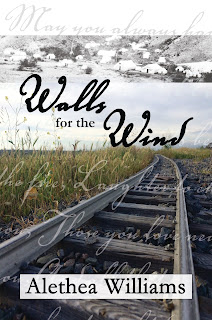
An interview with Connie Kennedy from the orphan train novel Walls for the Wind.

Alethea Williams:
Hello, I’m happy to be here today. Even though I wrote Walls for the Wind, I still have a few questions for some of the characters. Let’s start with Connie. Connie, you grew up in an orphan asylum. What did you expect when you came west with Kit on a train to distribute city children to farmers as the rails of the transcontinental railroad were laid west?

Connie Kennedy:
Well, to be honest with you, I thought it was going to be easy to make a lot of money doing almost nothing. After the war finally ended and the president was so tragically assassinated, people wanted to hear good news. And so that is what the newspapers were reporting at the time. There were breathless accounts of the westward expansion and all the opportunities in new settlements springing up along the rails, as well as numerous reports of huge, glittering gold and silver strikes in the West. It all sounded quite romantic.

Alethea:
And how did you find things on your journey west? Did conditions meet with your expectations?

Connie:
I discovered that it isn’t so easy to make a living as it had been made to appear. Most people out here work very hard for their money: the teamsters who haul the supplies to the end of the line, the railroad workers who build the bed and lay the rails, the hunters who keep the crews supplied with game, the lumbermen who fell the trees and shape them into ties and trestle timbers. I suppose even those who labor to relieve the railroad workers of their pay through liquor and gambling and other diversions could be said to work hard some of the time. It is difficult for virtuous women to find adequate means of sustenance.

Alethea:
And so you were disappointed in what you found at the end of your travels?

Connie:
If I did not want what I do want, I would like Cheyenne better. Cheyenne is a
bustling place, everything being made new from the ground up, and everybody is very busy when they’re not taking cover from flying bullets. But a frontier town in Dakota Territory isn’t what I wanted. I want fine fabrics and beautiful women patrons to drape them on. I want to design and make gowns that fashionable ladies will gladly pay fortunes to wear. So I would be happier somewhere more established, with a population of wealthy men with socially adroit wives. Denver, perhaps, or San Francisco. But have a look around you...I’m sure you think me a dreamer, a parvenue as the newspapermen traveling west with us have named me.

Alethea:
There’s nothing wrong with dreaming big dreams and striving to see them to fruition.

Connie:
(Sniffs.) Well, maybe you could take a moment and explain that to Kit.

Alethea:
You and Kit disagree on what your plans should be?

Connie:
Look, I know what you are about with these questions. You won’t get me to say a bad word about Kit in an interview for publication. There are those birds that fly a certain distance and then are content to halt and nest. And then there are those birds of more exotic plumage, who can’t wait to fly away and see what’s over the next mountain. Neither bird is wrong, necessarily, they’re just different. Kit will probably remain here in Cheyenne to the end of her days. But I certainly didn’t leave the children’s home in New York City to come west and do laundry and change nappies.

Alethea:
Connie, I hope everything works out for you. Thank you for talking with us today.

Connie:
My pleasure. Anything to be able to sit down in the middle of the day and get my poor reddened hands out of the washtub.

Walls for the Wind buy links:
Amazon

Author bio:
Western history has been the great interest of my adult life. I've lived in Wyoming, Colorado, and Oregon. Although an amateur historian, I am happiest researching different times and places in the historical West. And while staying true to history, I try not to let the facts overwhelm my stories. Story always comes first in my novels, and plot arises from the relationships between my characters. I'm always open to your response to my writing.

Twitter: @ActuallyAlethea https://twitter.com/actuallyalethea
The Romance Reviews author page: http://www.theromancereviews.com/ActuallyAlethea

Thursday, May 15, 2014

WRANGLE

WRANGLE is the debut novel of Texas author Jonnie Martin, inspired by her family’s farming and ranching history. In this literary western, Martin recaptures a particular place and time in Texas ranching history, and the human struggles of families in every place and time.  The book is available on Amazon paperback and Kindle format.


It is South Texas in the 1970s when quarter horse racing was still done on dirt tracks, and into this tactile and sometimes dangerous world comes city-bred Shannon Murphy to manage her father’s ranch and help him train up a promising filly.  Shannon takes to the work with a fervor.  When a tragedy occurs on the ranch and some blame Shannon, she self-exiles into the Davis Mountains to struggle with issues of life, love and this Texas notion of family.


Buy link:
http://www.amazon.com/Wrangle-Jonnie-Martin/dp/1494887312/ref=sr_1_1?s=books&ie=UTF8&qid=1393607827&sr=1-1&keywords=wrangle+by+jonnie+martin


Excerpt:
The wide, flat acreage gave Shannon Murphy an easy view of the dying sunset, but it wasn’t as if she had that all-seeing eye of providence.  There were drop-offs into gullies and dry arroyas, and a thousand acres of growing darkness — ample space for two-and four-legged creatures to hide and cause mischief.
Shannon crouched below the truck’s fender, leaning on the rifle stock, alert.  She could feel her chest rise and fall, but she contained the rale of her breathing.  Something had been stalking her calves.  A coyote most likely, maybe a wild dog.  A canine yipped in the distance, somewhere across the Brazos.
Todd Murphy fretted some about Shannon’s isolation on the ranch at night, him being a full hour away in Houston.  He cautioned her about wicked men lurking in the shadows.  Shannon shrugged off her father’s warning.  She noticed his grimace, accepted the sincerity of his concern, but ranching meant riding every inch of your land, despite the hour.  She was dogged about that responsibility and she welcomed the solid world stretching out before her.
Of course, there were fewer solitary evenings, now that Hayden aimed to be at
Tio Lobo often.  At this passing thought, Shannon conjured up a pleasing vision of Hayden Aldred, a tall, not-quite-meaty man with rusty hair that curled below the brim of his Stetson.  After a year of persistent courting, the Brenham veterinarian had been able to break through Shannon’s resistance, and now they fit together with a heat and an ease that suited them both.
Rising, Shannon let out a low whistle.  A ragged collie mix pulled his nose out of a tree stump he was rooting and jumped into the back of the truck despite lame hind quarters.  “Nothing to hunt tonight—he’s back across the river.” Shannon pounded on Dog’s sides, then climbed into the cab.  She started up the engine and took a slow wide turn, alert for movement, a stray calf, a predator.
March 5 and past the year mark, Shannon calculated.  Thirteen months managing the ranch and learning more every day, just by doing.  Her early years spent in Highland Park society had not prepared her for this job, but every Texas girl grew up on a horse—owned one or had friends that did.  She had country cousins on her father’s side who had taken her bareback riding; two handsome boys she called kissing cousins though she had never kissed them.  Just mooned over their beauty and pined their absence when they grew into men and moved west.
. . . .
She liked the physicality of this world.  There was always something to do, something to shovel or brand or plant or bale.  The work felt grounded; chores that called upon a strong body and a willing heart, and when it was done, she could see the result of her effort.  Shannon breathed in the sweet memories of the past year, of trying and doing, mixed with the pungent odors of loam and dung and sweat trickling through the layers of grit.
There was more than the work, of course.  There was Hayden, no small part of her happiness.  And the close relationship with her dad, making up for some of the patchy years of separation after her parents’ divorce.  Recently there had been a new turn—a shared vision to train up a quarter horse named Lady Caliente and make a mark in bush track racing, about the only game going in Texas in the mid-1970’s. 

Author bio:
Jonnie Martin is a native Texan, city-bred like the lead character in WRANGLE, but still attached to the land.  Early in her career she was a journalist with a Texas newspaper and continues to write about the western culture in her current home in Waller County.  Martin has a BA in Literature and Creative Writing and an MFA in Fiction.  She writes a weekly blog (Westerly Notes) on her website, www.jonniemartin.com.

Find Jonnie Martin on the web:

Monday, May 5, 2014

DARE TO DREAM


ActuallyAlethea is pleased to welcome Heidi Thomas today for the kickoff of the blog tour for her new Western historical novel, Dare to Dream.

Welcome.  Will you share a little bit about yourself? 
I am originally from Montana and grew up on a ranch riding horses. I have a background in journalism, but love writing fiction. I lived in Northwest Washington for 17 years before moving to north-central Arizona a year ago. I love hiking in the granite hills in the sunshine!

Are you a reader?  What types of books do you like best?  What author(s)? I’ve always been a voracious reader. I like all kinds of books from cozy mysteries and courtroom dramas to historical and literary novels. My favorite authors include fellow Montanan Ivan Doig, fellow historical western authors Jane Kirkpatrick and Susan Lang , John Grisham, Craig Johnson.

What did you want to be when you grew up? A writer and a teacher. 

Did you realize that dream? Yes! I am a writer by vocation and avocation, and I do teach classes in memoir and fiction writing.

What were you like in high school?  Class clown?  Nerd?  Cheerleader type? Definitely a Nerd—bookworm!

Do you have a favorite quote you’d like to share? Ernest Hemingway: “There are no great writers, only great re-writers.

Tell us about the journey that led you to write your book. From the time I could form letters, I asked my parents “How do you spell…?” I wrote little stories all through elementary school, worked on the school newspaper in high school, and then received my degree in journalism from the University of Montana. I wrote for newspapers and magazines for many years before returning to my first love—fiction. I’ve had three novels published now and will have my first non-fiction book out in September.

What gave you the idea to write your book? And where to set it? My trilogy is based on my grandmother who rode bucking stock in Montana rodeos during the 1920s.

What inspired you to write about the theme? It’s all about having a dream and following it, as the titles of my books say. My character, Nettie, had a dream, and I had a dream. We dared, and we followed, and we persevered.
Please tell us about your current release. Dare to Dream is the third in the “Cowgirl Dreams” trilogy and takes place in the 1940s. It is a story of continuing to pursue a dream but finding an alternate, fulfilling way to achieve it. The book is set against a backdrop of WWII and its affect on ranching and rodeo with women’s competition coming to an end.

What’s the most challenging aspect of writing? Most rewarding? Sometimes the most challenging thing is just finding the discipline to get to the writing. I do a lot of writing every day—several blogs, editing for other authors, and class preparation. Sometimes my WIP takes a back seat to that. The most rewarding thing is when someone takes the time to write to me and tell me how much they enjoyed my book or what it meant to them. That makes my day!

How do you go about the writing process? Are you a strict outliner, a seat-of-the-pantser, or somewhere in-between? I’m a “pantser”. I’ll make notes and have a plan in mind, but I don’t do a formal outline. Because of my journalism background, I’ve come to realize that my first drafts are my outlines. Then I need to go back and flesh out the characters and the story.

Tell us about the story behind your book cover. My first two books were published by one publisher who closed down last year. The cover for Cowgirl Dreams included a picture of my grandmother, which was a great conversation-starter. The cover for Follow the Dream depicted a story when Nettie and Jake (based on my grandparents’ experience) trailed their herd of horses 400 miles over steep mountain passes to find grass for them during the drought of the 1930s. My new publisher has republished the first two books along with Dare to Dream and their designer chose a theme of vintage cowgirls for all of them. People are asking me if that is a picture of my grandmother on the cover of Dare to Dream, but no, unfortunately it’s not. It does depict the trick-riding women of that era, however.


What steps have you taken to marketing your book? I’ve done a pre-order e-mail blast, I’m doing this blog book tour, and I’m setting up book signings and talks in my area. In August I will be doing a “reality” book tour in Washington and Montana that my publisher is setting up for me. And of course I’m on social media and have a website http://www.heidimthomas.com

Please tantalize us with a story blurb or excerpt.

Nettie slipped out of the saddle to close the gate. She hadn’t seen any wires down on the fence, but sometimes calves just got rambunctious and went right through.

“All right, Windy, time to go home and take some iced tea out to the guys.” Collecting her reins, she stuck her boot into the stirrup and started to swing her leg over to mount up.

At that moment a sagehen fluttered out of the brush. Windy snorted. Nettie grabbed for the saddle horn. The gelding threw up his head and bolted.

As Nettie hit the sun-baked ground, she felt her shoulder pop.

Lying still, trying to draw in a breath, Nettie heard Windy’s hoofbeats galloping away. Her chest felt like the horse had sat on it. When she could at last catch her breath, she rolled to one side and tried to rise. Pain in her shoulder radiated down her arm and up into her head. Bright spots exploded in her vision and her head spun. She lay flat again, groaning.

Time drifted by like a wispy cloud. How long she lay there, she couldn’t tell. Nettie opened her eyes. The sky was clear. No more bright spots. Home. Gotta get home.

Slowly, holding her left arm steady, she rolled to her right side. Pain shot through her shoulder. Bile rose in her throat. Taking deep breaths to still the pain, Nettie lay in that position until the nausea passed, then gingerly sat up. Dizziness threatened again and she fought to stay upright. Jake, help.
The afternoon sun drummed on her head, seared her eyes. Gotta get up. She looked around for a stick, something, anything to help her rise. A large sagebrush loomed just out of reach. Nettie tried to scoot her body toward the brush, but the pain washed over her again. Reaching down, she unbuckled her belt and inched it from her belt loops, grunting with the effort. She clumsily rebuckled it, eased it over her head, and slipped it under her forearm to cradle it close to her body.

With her right arm free, Nettie scooted closer to the sage until she could grab hold of a sturdy branch. She rested a minute and pulled herself to her knees. Then with a heave and a yell she stood. The amber hills seemed to sway against the sky. Her legs shook. Sweat poured down her back. No, not going down again. Holding on to her sage lifeline, she took deep draughts of air until the horizon righted itself.

Nettie took a step. Stopped. Let go of the brush. Took another step. Breathed deeply. Cradling her left arm close to her body, she tottered forward. Only a mile to the house. Home, she repeated in rhythm with her halting steps.
Stopping every few feet to catch her breath, she used her red bandana to mop her heated face. Jake, Neil, where are you?

The relentless sun continued its descent from directly overhead. Nettie kept putting one foot in front of the other. Home, home, home. Her heart pounded with the effort. Hours seemed to pass by, maybe even days… Home.

Tell us about your book and where it's available. Autographed copies are available on my website http://www.heidimthomas.com, also from the publisher http://www.globepequot.com  and Amazon.com
Aside from entertainment, what would you like people to take away from your book? Encouragement to follow a dream.
Can we look forward to reading about you again anytime soon? My non-fiction book about the old-time rodeo cowgirls of Montana, Cowgirl Up!, will be out Sept. 2

What's next for you? I’m working on the 4th in the series, An American Dream, about the next generation.


Where can readers find you on the web? 
Facebook: https://www.facebook.com/heidi.thomas.9085
Twitter: @Heidiwriter
LinkedIn: https://www.linkedin.com/profile/view?id=34326855&trk=nav_responsive_tab_profile


My next blog tour stop will be tomorrow at Janet Fisher’s blog http://janetfisherbooks.wordpress.com/ where I'll be talking about how my books came about.

There are some awesome prizes in Heidi's DARE TO DREAM giveaway: Choice of one of my “Dreams” books, woven bookmark, denim potholder, Dare to Dream ornament, “Dreams Do Come True” fridge magnet, Cowgirl soap and more. Comment here with your email, or visit http://www.heidimthomas.com

Thanks for stopping by!