Monday, May 21, 2018

Sewing Machines and Joy That Long Endures

second in the Irish Blessings series of early Wyoming historical novels.

Sewing Machines

Mention 1872 and sewing machine in the same sentence, and invariably people envision the ubiquitous Singer treadle-operated model. One of the characters in the second of my Irish Blessings novels, Joy That Long Endures, is a traveling seamstress. Her sewing machine is described more than once as hand-cranked, and I wrote about her having gone to some trouble to have a special case made for it so it could travel with her. The machine is described as heavy, but not so bulky that she can’t carry it herself. 

From an 1865 Shaw & Clark pamphlet.

There were various models of sewing machines invented between 1790 and 1807, but the first working chain stitch model was patented by a French tailor in 1830. He opened a sewing machine based clothing company to manufacture army uniforms, but the factory was burned down, perhaps by persons fearing for their jobs. The American Walter Hunt invented a lockstitch machine in 1832, selling individual models but not patenting his invention until 1854.


From a W.A. White & Co. pamphlet, 1871.

John Fisher, an English inventor, beat Isaac Merritt Singer’s similar machine to production by seven years. In a legal dispute, Singer won the patent race over Fisher. In the 1850s and 1860s the firm of Wheeler and Wilson sold many quieter and smoother-operating machines.


Individual improvements and innovations by numerous companies led to a Sewing Machine War. Instead of continually fighting each other in court four companies pooled their patents and required anyone making use of them to pay $15.
Clothing manufacturers were the first to use sewing machines for factory-made clothing in standardized sizes, but by the 1860s there were many examples of such machines in private homes. Items of clothing that had previously taken hours to stitch together could be whipped up in minutes. Women who previously had no financial employment outlet could seek jobs outside the home. The demand for cotton fabric rose, metals industries profited from making sewing machine parts, and many household goods manufacturers benefited from the increased productivity provided by the use of machines.
According to TIME Magazine, Lady’s Book, a fashion magazine, enthused: “Next to the plough, [the sewing machine] is perhaps humanity’s most blessed instrument.” Certainly the ability to speedily add yards of embellishment like ribbons and lace changed the ladies’ fashion industry. Singer himself grew rich from the profits of sales of his machines, many sold on the installment plan to women who couldn’t afford to part with the total price at once.
So certainly by 1872, clever seamstress Ailis Tierney who made her living following and outfitting a traveling dance troupe, could have found any number of table-top, hand-cranked sewing machines to modify to her portable use with a custom wooden case—long before Singer seized on the idea in 1911 with his Model 99.

Some sources:


Before The Hon. Philip F. Thomas, Commissioner Of Patents. In The Matter Of The Application Of Elias Howe, Jr., For An Extension Of His Patent For Sewing Machines. Testimony Taken On The Part Of The Applicant, Elias Howe, Jr. New York: Wm. W. Rose, Job Printer, 1860.

The Sewing Machine. Its History, Construction, and Application. Translated from the German of Dr. Herzberg by Upfield Green. London: E. & F.N. Spon, 1864.

Genius Rewarded; The Story of the Sewing Machine. New York: John J. Caulon, Printer, 1881.

First in the Irish Blessings Series of early Wyoming historical novels, Walls for the Wind:


Bio:


Alethea Williams is the author of Willow Vale, the story of a Tyrolean immigrant’s journey to America after WWI. Willow Vale won a 2012 Wyoming State Historical Society Publications Award. In her second novel, Walls for the Wind, a group of New York City immigrant orphans arrive in Hell on Wheels, Cheyenne, Wyoming. Walls for the Wind is a WILLA Literary Award finalist, a gold Will Rogers Medallion winner, and placed first at the Laramie Awards in the Prairie Fiction category. Partially based on the works of Canadian trader, explorer, and mapmaker David Thompson, NáápiikoanWinter spans a continent, examining the cultures in flux at the passing of one era and the painful birth of another. Náápiikoan Winter was an Inspirational Western Fiction Will Rogers Medallion Bronze winner, and a Best Regional E-book Independent Publisher Bronze winner. Joy that Long Endures, the second of the Irish Blessings historical novels, spans western early Wyoming Territory from the rails at Bryan City to the goldfields of South Pass City. 

Find Alethea Williams:


Saturday, November 18, 2017

Books for Christmas from Wyoming Writers members


Yellowstone Has Teeth
In this well-constructed narrative, Ambler reveals a hidden Yellowstone, a place where delight and danger are separated by the slimmest of margins: a degree of pitch on an avalanche slope, a few inches of a buffalo’s horn, a moment during a deadly wildfire. With insight, love, and humor, Yellowstone Has Teeth paints a never-before-seen portrait of an iconic American landscape and the people who live there.


The Deadly Art of Love and Murder

amazon.com/Deadly-Art-Love-Murder-Caribou/dp/1946063371/

Alaskan fine arts dealer, Caribou King, has closed up shop for the season. When she discovers the body of Mrs. Nash, an elderly woman, in the old Tilamu house, Cara can’t help poking her nose into the investigation. With the Alaskan winter closing in, Cara finds herself caught between two men who say they love her and one who wants her dead.


Along the Sylvan Trail
amazon.com/Along-Sylvan-Trail-Julianne-Couch/dp/1944986227/

In Sylvan Grove, Iowa, you can eat at Sally's Sylvan Diner, shop at a family business in the square, read your news in the Sylvan Grove Gossiper, spend the night at the Sylvan Inn, and live out your final days at the Sylvan Valley Care Center. But if you are budding plant scientist Amber Jensen, Sylvan Grove is your touchstone, the place to heal a broken heart and start a new life restoring an historic bar in the foothills of Wyoming's Wind River Mountains.


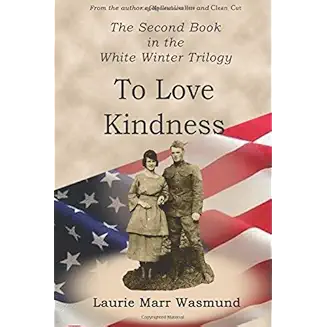
To Love Kindness

amazon.com/Love-Kindness-White-Winter-Trilogy/dp/0985967552/

1918 At a time when it takes courage to love, hope, or have faith, three young Irish-American dare to believe in themselves and in America. Meticulously researched, this second book in the White Winter Trilogy explores how hope is shattered and rekindled, hearts are broken and mended, and faith is lost and found in a world in which nothing is certain.


Náápiikoan Winter

amazon.com/Naapiikoan-Winter-Alethea-Williams/dp/1532710569/

At the turn of a new century, changes unimagined are about to unfold. When white traders approach the Piikáni for the first time, no one can reckon the price that will be paid. Naapiikoan Winter is a Will Rogers Medallion Awards bronze level winner.

Wednesday, December 7, 2016

GARDEN OF HER HEART

blog-tour
USA Today Bestselling Author Shanna Hatfield joins us with her latest release, a sweet World War II romance.


break-2


garden-of-her-heart-cover

Can forbidden love blossom

amid the constraints of war?

The moment the Japanese bombed Pearl Harbor, life shifted for Miko Nishimura. Desperate to reach the Portland Assembly Center for Japanese-Americans, she’s kicked off the bus miles from town. Every tick of the clock pushes her closer to becoming a fugitive in the land of her birth. Exhausted, she stumbles to her grandparents’ abandoned farm only to find a dying soldier sprawled across the step. Unable to leave him, she forsakes all else to keep him alive.


After crashing his plane in the Battle of the Atlantic, the doctors condemn Captain Rock Laroux to die. Determined to meet his maker beneath a blue sky at his family home, he sneaks out of the hospital. Weary and half out of his mind, he makes it as far as a produce stand he remembers from his youth. Rather than surrender to death, Rock fights a battle of the heart as he falls in love with the beautiful Japanese woman who saves his life.


A poignant, sweet romance, Garden of Her Heart proves love can bloom in unlikely places even under the most challenging circumstances.

Don't miss out on this beautiful happy ever after. Get your copy today!


Available on:


gohh-party-banner


Join us for a Facebook Party today (December 7) from 4-7 p.m. (EST) to celebrate the release of Garden of Her Heart. Here is the link:


https://www.facebook.com/events/1387228264628190/


break-2


Excerpt:


Dazed and drained, Miko came to her senses as she reached a road she recognized in the predawn light. It led to a farm owned by one of her grandparents’ neighbors. If she cut through their pasture, it would save her a few miles of walking.


She pushed down the wires of the fence and stepped over it, then reached back for her suitcase. The barbed wire caught her coat. Miko jerked it away from the snag and rolled her eyes in frustration when the fabric ripped.


Sudden anger, at herself for her own arrogance and stupidity as well as the circumstances that left her walking through the woods in the rain at night, fueled her steps. Indignation lent her spent body strength as she hurried across the pasture. A few cows tossed uninterested glances her direction, but none moved her way.


Relieved when she reached the far end of the pasture, she hurried over the fence and along the edge of the trees that circled the vast acres her grandparents owned.


The first fingers of dawn stretched across the drab sky as she stepped from the trees and swallowed back a sob at the sight of her grandparents’ produce stand. As long as Miko could remember, her family had sold produce from the red-painted structure filled with shelves and bins to hold every type of vegetable and fruit the fertile soil would grow.


A hundred yards behind the produce stand, a white picket fence surrounded the cheery yellow bungalow home her grandparents had built in the mid-1920s. With a wide porch and a plethora of flowers surrounding all four sides, the house appeared welcoming. Beyond the yard, a barn and large storage building, along with a collection of outbuildings, alluded to a prosperous farm.


With a prayer to find her family waiting inside for her, she raced up the front steps of the porch and tried the door. The knob rattled but didn’t turn, locked from the inside. Miko set down her suitcase and rushed around to the back door. In her haste, she tripped over the body of a man as he sprawled across the back step.


Unconscious, the uniformed soldier shuddered against the chill in the air, his clothes every bit as wet as hers. At least his jerky tremors assured her he wasn’t dead.


Panicked, she pounded on the door. “It’s Miko! Open the door! Please!” Fist banging against the wood, she called out to her grandparents, willing them to be there.


All remained eerily silent in the house. Single-minded in her efforts to enter the dwelling, Miko stepped over the man and lifted a brick from the border edging the flowerbed. With a spare key in her hand, she jammed it in the lock and pushed the door open, rushing inside.


gohh-gif


break-2


shanna-3
USA Today Bestselling Author Shanna Hatfield writes character-driven romances with relatable heroes and heroines. Her historical westerns have been described as “reminiscent of the era captured by Bonanza and The Virginian” while her contemporary works have been called “laugh-out-loud funny, and a little heart-pumping sexy without being explicit in any way.”


Convinced everyone deserves a happy ending, this hopeless romantic is out to make it happen, one story at a time. When she isn’t writing or indulging in chocolate (dark and decadent, please), Shanna hangs out with her husband, lovingly known as Captain Cavedweller.


Find Shanna’s books at:

Amazon | Amazon UK | Barnes & Noble | Smashwords | Apple | Audible

Shanna loves to hear from readers. Follow her online at:

ShannaHatfield | Facebook | Newsletter | Pinterest | Goodreads | You Tube | Twitter


Thursday, October 6, 2016

Native American Slavery

(This is a reprint of an essay originally published on Andrea Downing's blog.)

Native American Slavery
by Alethea Williams

In sofar as the taking of captives and reducing them to slaves was concerned the Apache acquired this custom from the Spaniard or Mexican, and it is safe to say that during the period of which I write there was not a settlement in the valley of the Rio Grande that did not number among the inhabitants a large number of Apache and Navajo Indian slaves.
—Ralph Emerson Twitchell, The Leading Facts of New Mexican History, Torch         Press, 1917

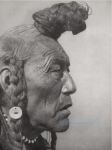
photo of a Blackfoot by Edward Curtis, hairstyle described in Naapiikoan Winter as a similar one worn by the character Saahkómaapi (Young Man), Beaver Bundle Man to the Inuk’sik band of the Piikáni, the band’s Dreamer
Photo of a Blackfoot by Edward Curtis, with a hairstyle described in Naapiikoan Winter as one worn by the character Saahkómaapi (Young Man), Beaver Bundle Man to the Inuk’sik band of the Piikáni, and the band’s Dreamer.

The primary female character in my novel, Náápiikoan Winter, is abducted as a child and later traded into slavery. She is abducted by Apaches, sold by Utes, and enslaved by other tribes including the Piikáni. Was it true that Native Americans learned this practice from contact with the Spaniards, as the quotation that opens my book asserts?
Although it’s true Christopher Columbus started an unholy tradition by enslaving over 500 Indians, an article on the website Oxford Research Encyclopedia: American History by Christina Snyder says, “The history of American slavery began long before the first Africans arrived at Jamestown in 1619. Evidence from archaeology and oral tradition indicates that for hundreds, perhaps thousands, of years prior, Native Americans had developed their own forms of bondage.” Indians captured women and children to replace the up to 90% of their people killed by war and diseases they had no defense against. In an article for Slate, Rebecca Onion says “Native types of enslavement were often about kinship, reproductive labor, and diplomacy, rather than solely the extraction of agricultural or domestic labor.”
All Native tribes that I know of were called “The People.” What this common nomenclature implies is that the people of one’s tribe were People, and all others were something less. Captives were outside society, but slaves were even further outside the social order. So as a slave passed from tribe to tribe, my character Buffalo Stone Woman would have had many instances of rejection and neglect. For most of her adult life, she would not have been accepted by anyone as a true person, but a creature somewhere on a level with a dog or other tamed animal.
There were ways to escape the status of captive, enshrined in solemn ceremony, that could make of a mere captive a real person by adoption or marriage. Slaves were of a different nature, “distinguished by the extremity of their alienation from captors’ societies and the exploitation of their labor to enhance the social or material life of the master,” according to Snyder. Slaves often had a lot of freedom to come and go in the performance of their duties. And slavery wasn’t a hereditary condition: children of Indian slaves were not themselves enslaved.
So in Náápiikoan Winter, when Buffalo Stone Woman finds a home at last among the Piikáni at the base of the Rocky Mountains where although a slave she has attained the status of a distant wife to the powerful Orator, she wants never to have to leave this safe haven. She is tolerated, even accepted. She brings to her new people her skills and her knowledge, which makes them, already powerful, an even more potent force on the Plains.

A photo of a woman wearing an elk tooth dress, a sign of high regard.  Lucy Crooked Nose - Cheyenne - 1898 - forums.powwows.com